
TLDR:
Improve your medical practice’s online reputation in 2026 by:
- Collecting recent, genuine reviews consistently instead of sporadically.
- Keeping listings, provider profiles, and practice information accurate everywhere patients look.
- Responding to feedback promptly and professionally, including negative reviews.
- Auditing your online presence first, then tracking a few key metrics monthly to see what’s working.
- Keeping the same information accurate for AI assistants, which now pull from these same signals to answer health questions directly.

One in three U.S. adults now use AI chatbots for health questions, such as diagnosis based on symptoms, treatment options based on diagnosis, and information about prescription drugs and side effects. Patients research a practice’s reviews, listings, search results, and website long before they book an appointment. This guide will walk you through how to improve online reputation in 2026, one step at a time.
Why does Online Reputation Management Matter for Medical Practices?
Online reputation management matters for medical practices because it shapes how prospective patients perceive a practice before they book an appointment. Positive reviews can improve local search visibility, build confidence in your providers, and help turn online interest into new patients. Accurate listings and a steady flow of recent reviews also reinforce trust. On the other hand, poor ratings, outdated information, or unresolved complaints can discourage patients from choosing your practice. A strong online reputation helps practices stand out in search results, build credibility, and create a more positive first impression that supports both patient acquisition and retention.
What Does a Strong Online Reputation Look Like for a Medical Practice?
A strong reputation for a medical practice rests on four visible pillars: genuine recent reviews, accurate public information, complete provider profiles, and timely responses to feedback. Your reputation is a direct reflection of how your practice is perceived by current and prospective patients. From reviews and ratings to accurate listings and responses to feedback, every element can influence your practice’s credibility. Effective healthcare online reputation management shows up in four visible ways:
- Reviews: recent and genuine reviews across Google, G2, Yelp, etc., with thoughtful responses.
- Public information: hours, locations, specialties, insurance accepted, and provider details that match across Google, directories, and your website.
- Profiles: complete provider bios, recent photos, and simple booking.
- Responsiveness: a professional reply to every piece of feedback.
How to Audit Your Medical Practice’s Online Reputation
Audit your reputation by searching your practice the way a patient would, then checking your reviews and listings for accuracy and recurring themes. The information you publish yourself is only one part of your online reputation. Search results, third-party directories, provider profiles, and patient reviews all contribute to the perception prospective patients have. An online reputation audit helps you understand that perception as a whole and identify where it may differ from how you want your practice to be represented.
Search Like a Patient
Search your practice name, each provider’s name, and your specialty plus your city in a private browser window. Read the entire first page: your Google Business Profile, directory listings, your website, and any third-party content. Check whether hours, specialties, locations, provider bios, and booking paths are accurate and consistent across your business listings and website.
Check Reviews, Listings and Recurring Themes
Look at review volume and recency, not just the star rating. Note recurring positives and complaints, incomplete profiles, inconsistent listings, and gaps between your website and third-party directories. This inventory is the starting point, and ongoing online reputation monitoring keeps it current. Quick Tip: Run your practice through LEAP’s free Online Visibility Tool for a starting snapshot of how your practice appears online in minutes.
How to Improve Your Medical Practice’s Online Reputation
Once the audit is done, it comes down to four ongoing actions: collecting reviews consistently, keeping public information accurate, monitoring and responding to feedback and measuring what changes.
Step 1. Create a Consistent Review-Collection Workflow
Ask every eligible patient for feedback in the same way, at the same point in their visit. Trigger a review request by SMS or email shortly after the appointment, or offer a QR code at checkout, and link directly to the review platform. Getting more patient reviews only works if leaving feedback takes under a minute, so keep the path short. A steady stream of authentic reviews signals an active, trusted practice. Check current platform policies and FTC guidance on consumer reviews and testimonials before launch. Avoid review gating, such as asking only satisfied patients to leave public reviews while directing negative feedback elsewhere, and do not offer incentives tied to positive reviews.
Step 2. Strengthen the Public Information Patients Rely On
Make sure your practice information is updated before you focus on getting a five-star rating. Keep hours, locations, specialties, services, provider information, phone numbers, and booking links accurate and consistent across your website and every major listing. Platforms, like Leap, support centralized listings management, so one update publishes everywhere instead of being edited directory by directory.
Step 3. Monitor, Respond and Learn from Feedback
Keep track of feedback across the platforms your patients use and establish a process for responding within a reasonable timeframe. For medical practices, those responses also need to protect patient privacy. Never confirm publicly that a reviewer is a patient or reference diagnoses, appointments, treatment details, or other protected information. Responses should follow current HHS Office for Civil Rights guidance on HIPAA and your practice’s privacy policies. When feedback is negative, respond professionally and carefully. Keep the response brief and courteous, acknowledge the concern without discussing specifics, and invite the reviewer to continue the conversation through a private channel. Reviews also reveal problems ratings alone can’t like recurring complaints about scheduling, hold times, billing, or communication point to fixable operational friction. Treating feedback this way turns reputation management into a tool for improving patient experience. Step 4. Measure the Changes That Matter Track a short list of indicators monthly: review volume and recency, rating trend, response time, sentiment themes, listing accuracy, and search visibility. Where possible, connect the work to outcomes such as new-patient bookings or online appointment requests. Trend analysis shows which actions move results and which are busywork. 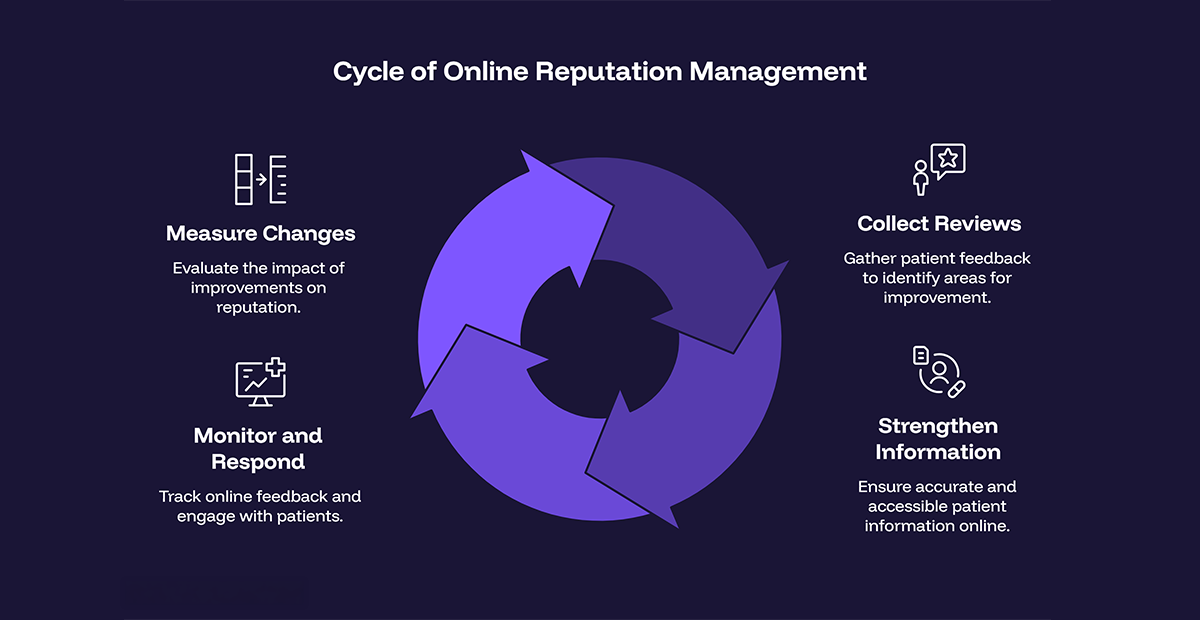
How Can AI and Automation Support Online Reputation Management in 2026?
AI and automation support online reputation management in 2026 in two ways: by monitoring and responding to feedback faster, and by shaping how AI assistants themselves describe a practice to patients. On the monitoring side, AI reputation management tools track reviews across platforms continuously, summarize sentiment, and flag urgent feedback faster than a manual check would catch it. That shortens response time, but a person still has to read the alert and decide what to do; what changes is how fast that person finds out. On the discovery side, AI assistants now answer questions like “good dermatologist near me” by pulling together the same information a patient would gather by hand:
- Entity: practice name, provider names, specialty, and location.
- Facts: address, hours, accepted insurance, services, and appointment availability.
- Trust: review volume, recency, consistency, and third-party mentions.
- Authority: the practice website, provider bios, directory profiles, and reputable external sources.
Keeping these signals accurate and consistent is becoming an important part of AI search reputation management, and this is where LEAP brings the pieces together. LEAP Reputation Management centralizes review monitoring, uses AI-driven alerts and sentiment insights to help practices identify feedback that needs attention, and supports listings management to keep practice information consistent across search engines, AI engines and healthcare directories. Instead of managing reviews, listings, and reputation signals through separate workflows, practices can monitor and manage their online presence from one platform. As AI becomes part of how patients discover and evaluate providers, this approach strengthens the same digital foundation behind both search visibility and AI-assisted discovery.
How Much Does Online Reputation Management Cost?
There is no single price for online reputation management: costs range from free (DIY) to a few hundred dollars a month (software) to higher managed-service fees, depending on review volume, number of locations and platforms, listings management, monitoring depth, automation, reporting, and AI functionality. Practices generally choose among three approaches:
| Approach | Best for | Staff Effort | Automation |
| DIY | Small, single-location practices | High | Low |
| Managed service | Small to Mid-sized practices | Low | High |
| Reputation software | Multi-location practices | Low to Medium | High |
Comparison of Reputation Management Pricing Approaches Online reputation management for physicians in a solo or small practice often starts with software or a managed service, depending on how much internal staff time is available to run it day to day. LEAP Reputation Management sits in the managed service category. It pairs automated review requests, centralized monitoring, listings management, and AI insights with hands-on support, so a practice gets full-service reputation management without building that workflow in-house.
Bottom Line
Improving your online reputation in 2026 is an ongoing cycle of auditing your presence, correcting inconsistencies, listening to patient feedback, responding thoughtfully, and measuring what changes. Done consistently, these efforts help build patient trust, strengthen online visibility, and create a more accurate picture of your practice wherever patients search.
Practices using LEAP have reported a 40% growth in their digital footprint with consistent listings and enhanced visibility.
Explore LEAP Reputation Management to see how your practice can manage and strengthen its online presence at scale.
Author Name: Emma Zane | Read Time: 7-8 minutes | Last Updated: August 31, 2026